Start with the foreground
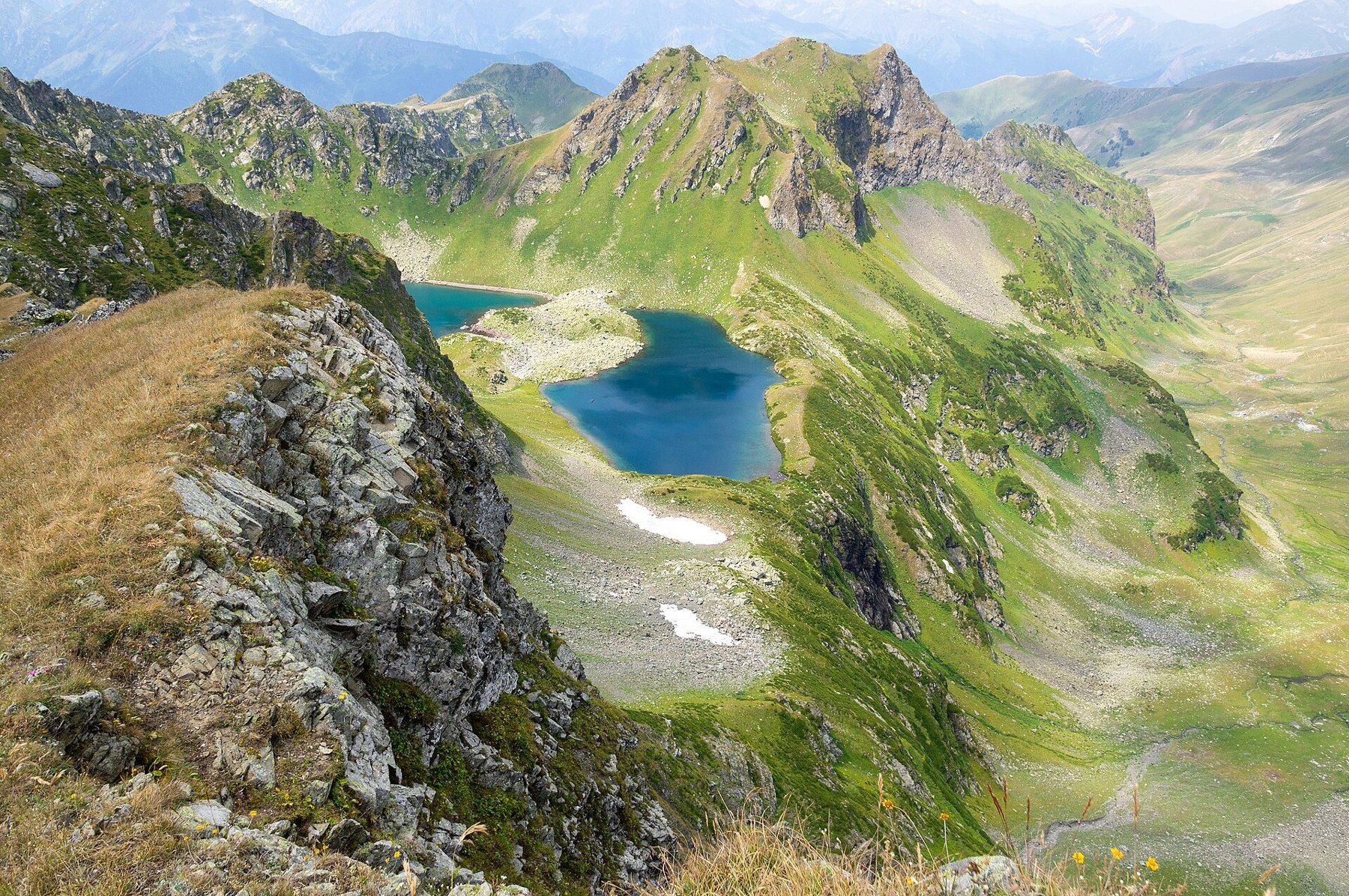
A wide landscape often suggests an order for our attention: first the highest peak, then the bright water, then everything else. Small details can go unnoticed as a result. Try setting the main subject aside for a minute and looking at what is closer. The edge of a stone, dry grass and the strip of ground beneath your feet give your eye somewhere to begin. From here, distances are easier to follow: beyond the grass a slope begins, behind it lies water, and farther away the opposite shore rises. The highest peak is still there, but now you can also see what separates it from you.
An open view from a walking path, an urban waterfront or the edge of a park will do for this exercise. Choose somewhere you can stop comfortably without getting in anyone’s way. Do not approach a cliff edge for the sake of a striking foreground. You can vary the view from the path, too: turn towards the slope, include its foot in the frame or look along the shore. Look around without a camera first. This makes it easier to find a nearby detail that really connects with the distance, and to notice what blocks the view.
Three distances instead of one view
Divide what you see into near, middle and far. In the foreground, look for texture: roughness, individual stems, small shadows. In the middle distance, look at the relationships between shapes: how a slope enters a valley, where a pale band crosses a dark one, what hides behind an outcrop. In the distance, look at silhouettes and the gaps between peaks. This makes it easier to study a view with too many details to take in at once. Sometimes there is almost no middle ground; sometimes a cloud hides the distance. A missing part of the scene is something you can notice and describe, too.
Now trace an imaginary line with your eyes from the nearest detail to the farthest. It might follow a bend in the shore or the edge of a slope. Do not force every object into a pleasing arrow. It is more interesting to notice where your eye stops: at a contrasting patch, a sharp boundary, a solitary tree. If you are taking photographs, make two images from the same spot, one with the nearby detail and one without it. Later, compare which image gives a better sense of the distance to the far slope.
Leave room for the sky
Try placing the horizon above or below the middle of the frame. Its position changes what receives more attention. If the folds of the land matter most, the sky can remain a narrow strip. If clouds and openings hold your attention, the land needs only the lower edge. Try both versions, then return to looking freely without a screen. The rule of thirds can help you begin, but it should not decide for you. An even division sometimes conveys stillness more precisely than carefully arranged asymmetry.
Pay attention to the edges of the image as well. A bright stone accidentally cut off by the frame can compete with the main subject more strongly than an entire distant mountain. There is no need to clear the area or move natural objects: a slight change in the direction of the camera is enough. Look at what has appeared at the opposite edge after you turn. Removing a stone can easily bring a branch or a piece of path into the frame. Check the whole frame once more before taking the photograph.
What stayed outside the frame
At the end, choose one detail you will be able to recall without a photograph. For example: pale scree beneath a dark ledge, water between two slopes, a thin strip of sky above the forest. Write one sentence. If you want to add more, describe what stayed outside the frame. This second note often explains the photograph better than the first: it makes clear why the frame ends exactly here.
You can add a small sketch to the photograph: the edge of the foreground, the line of the distant slope and the position of the horizon. Details would only get in the way of comparison here. If you return to this view, begin from a different edge of the scene, then find your previous spot. Compare which distances are still easy to distinguish and what is now obscured. Leave a new note beside the old one, keeping both descriptions: you will be able to see exactly what has changed in your account.